Reclassify Components within Asset Classification
For reclassifying Components between Component Types within their Asset Classification, there are two (2) methods available. Each of these processes are outlined in this document:
- Reclassify Components within a Single Asset
- Bulk Reclassification of Components within Asset Classification
Reclassify Components within a Single Asset
To reclassify a component within its parent asset, perform the following steps:
-
Navigate to the main ‘Assets’ page and make a selection from the map screen.
-
At the top of the info panel, click the ‘Actions’ menu.

-
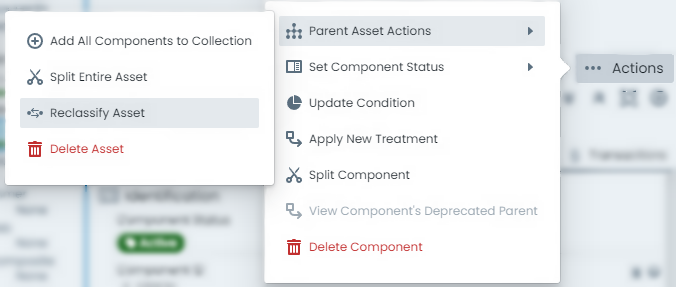
From the ‘Actions’ menu options, hover or select ‘Parent Asset Actions’ and then choose ‘Reclassify Asset’. Note, if the Info Panel is already focused on the Parent Asset record, the ‘Reclassify Asset’ will be in the initial Actions menu.
-
A fly-out panel will appear with the required tools for performing an asset reclassification. Set the the ‘Reclassification Mode’ to ‘Component Reclassification’.
 Info
InfoThere is no need to choose a target asset classification, as the components are being reclassified within their current asset classification.
The target Asset Classification control will be disabled when you choose ‘Component Reclassification’ mode.
-
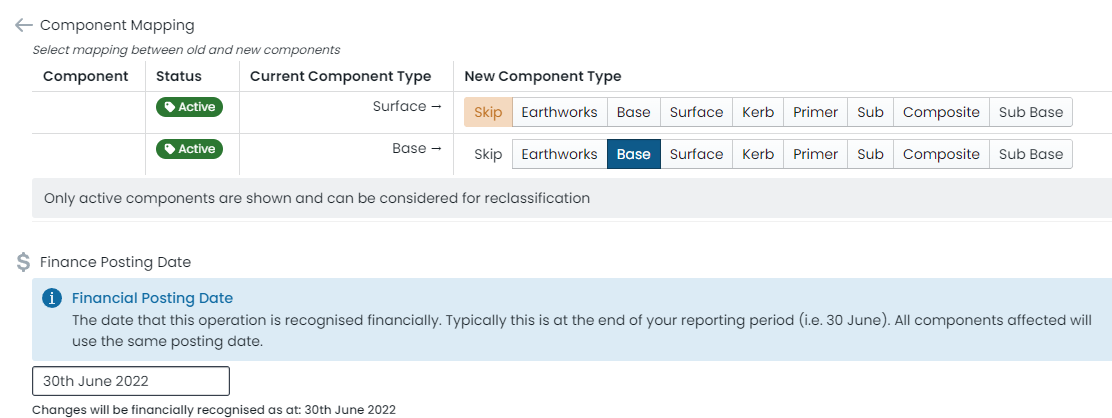
Once the mode has been set, the ‘Component Mapping’ section will become active. Each of the active Asset’s Components can be matched to a corresponding Component Type within the Parent Asset’s Asset Classification.
For components in the mapping list that you wish to reclassify to a different Component Type, select the ‘New Component Type’ on the right-hand side. Otherwise, leave it set to ‘Skip’.
-
With the component mapping complete, use the calendar control to set the desired ‘Effective Date’ for the operation to occur. This defaults to the current date.
-
You can now proceed to ‘Preview the Reclassification’. This will submit your settings to test if the reclassification will be valid. In the case that any issues are found, these will be returned to you and rendered just above the preview button.
This process is essentially checking that the Component Types are compatible, and that any data loss can be avoided.
-
When you are ready with the proposed reclassification, click ‘Reclassify (immediate)’.
Bulk Reclassification of Components within Asset Classification
To reclassify components within their parent assets in bulk (across many Assets), perform the following steps:
-
Navigate to the main ‘Assets’ page and make a collection from the map screen.
-
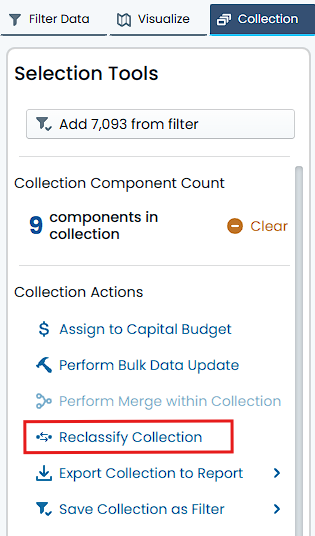
From the Collections panel, in the ‘Collection Actions’ section, choose ‘Reclassify Collection’.
-
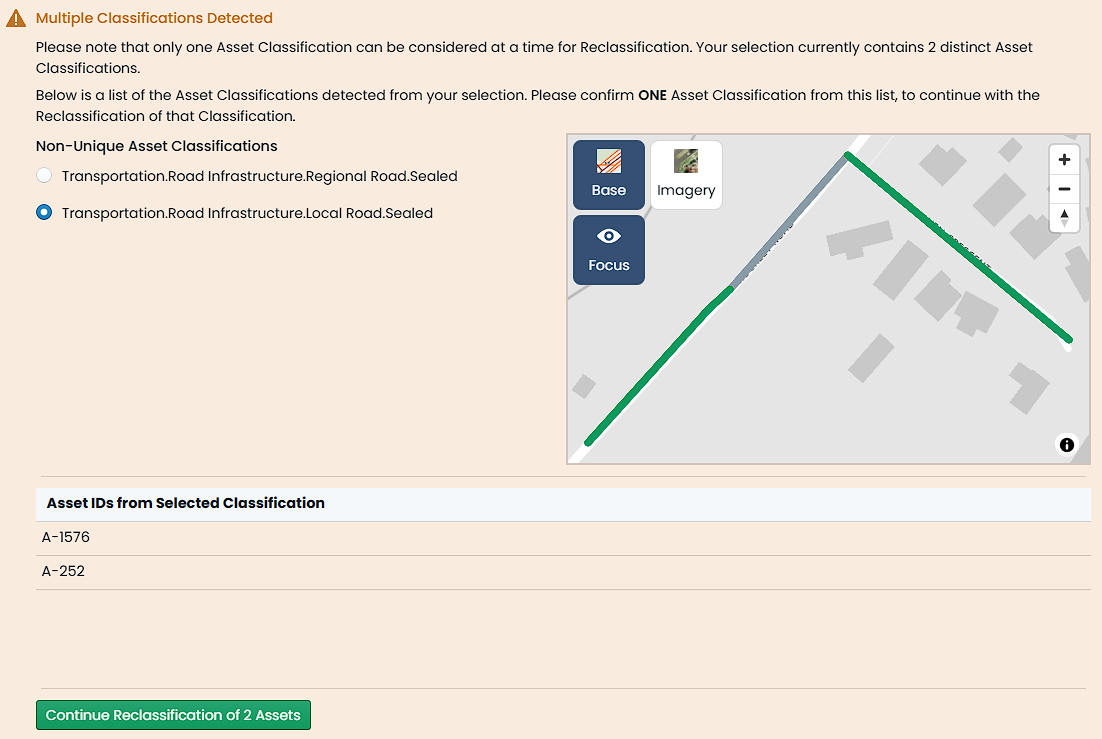
A fly-out panel will appear with the required tools for performing an asset reclassification. Before you start however, the system will review your collection to ensure it contains just one distinct Asset Classification. If more than one is found, don’t panic, the system will guide you through refining your collection so that the scope of the collection is reduced to a single classification.
-
With a single classification confirmed, set the the ‘Reclassification Mode’ to ‘Component Reclassification’.
InfoThere is no need to choose a target asset classification, as the components are being reclassified within their current asset classification.
The target Asset Classification control will be disabled when you choose ‘Component Reclassification’ mode.
-
Once the mode has been set, the ‘Component Mapping’ section will become active. Each of the Component Types within the Asset Classification can be matched a different Component Type within the Asset Classification, or left unchanged.
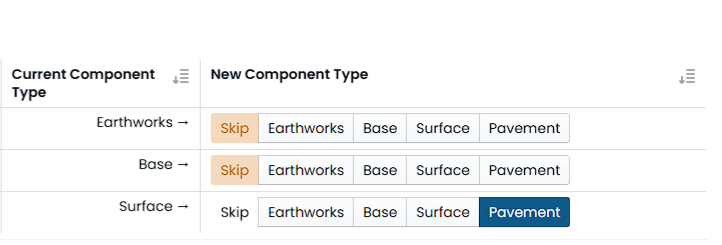 Info
InfoNote: This is slightly different to the single component reclassification mode, where the mapping is performed at the individual component level. In bulk reclassification, the mapping is performed at the component type level. This means that all components of a given type will be reclassified to the same target component type.
-
With the component mapping complete, use the calendar control to set the desired ‘Effective Date’ for the operation to occur. This defaults to the current date.
-
You can now proceed to ‘Preview the Reclassification’. This will submit your settings to test if the reclassification will be valid. In the case that any issues are found, these will be returned to you and rendered just above the preview button.
This process is essentially checking that the Component Types are compatible, and that any data loss can be avoided.
-
When you are ready with the proposed reclassification, click ‘Reclassify (immediate)’.